














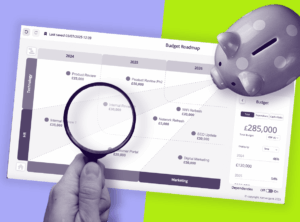
Doing more with less. Driven by your strategic roadmap.
Doing more with less is the challenge facing Mid Cap Business Leaders in 2025. We explore the challenges this poses, the fix, and how a strategic roadmap that is accessible can make a difference.

Introduction
If you are like any business or technology leader Konexis knows, your primary goal for 2025 is to do more with less. How can I use technology to reduce employee spending without affecting customer experience?
However, it is more complex than installing a shiny new ERP that the vendor promises will ensure that AI agents will complete 80% of your back-office tasks in 6 months. A new IT system, even AI, is rarely the silver bullet you would hope it would be, as I am sure that various failed digital transformations in your past would testify. AI is promising a huge amount, but right now, it is an incredible tool, but a tool nevertheless often operates in silos. If you are not looking at a transformation programme from the perspective of people, processes, data and systems, then you will never have the whole picture, and you are likely to be part of the 70% of transformations that fail.
The other aspect that we have seen that needs urgent addressing is how strategic roadmaps are developed and presented back, not just at the boardroom level but across the broader company. However, what should the main strategic objectives or your strategic roadmap look like?

1. Your number one goal is improved efficiencies
The Deloitte Growth Study found that companies transitioning from £50M to £200M revenue face critical operational breaking points where manual processes and basic systems no longer scale, which often means doing less with more (staff). The exact opposite of what you are looking to achieve.
Research shows that organisations often maintain legacy processes and structural inefficiencies that inflate staffing costs across multiple departments – from customer service to finance and operations. This is particularly true when an organisation has grown through acquisition and merger and has yet to consolidate its back office systems (IT, HR, Legal, Finance, Property) into a shared services function. Gartner found that mature shared service centres can reduce operational costs by 30-40% compared to decentralised operations, whilst McKinsey found that you would typically get an ROI in 2-3 years, and the Hacket Group concluded that it could reduce the cost of the transaction by 43%.
Though how do you approach this as a whole rather than through individual silos? A methodical approach to identifying opportunities to streamline operations, reduce unnecessary manual touchpoints, and optimise resource allocation can deliver substantial benefits without compromising service quality. By mapping end-to-end processes and understanding where value is created, organisations typically uncover opportunities to reduce operational costs through automation, process simplification, and eliminating duplicated effort.
Fix:
A holistic view of the operating model enables businesses to identify where to consolidate functions, automate routine tasks, and reallocate resources to higher-value activities. This approach to operational transformation can reduce overhead costs while improving customer satisfaction and maintaining the agility needed to scale efficiently. We take this view as a bottom-up approach, focused on process improvements, which will generate quick wins but rarely address the more significant challenges ahead. It has the effect of delivering quick wins whilst identifying long-term savings.

2. You are concerned that the disjointed nature of your systems leads to a poor customer experience
Your technology has evolved organically, primarily focusing on building in-house solutions or COTS systems that need better integration. This has resulted in a complex and fragmented system landscape, with duplication and significant technical debt. This can cause internal frustration and create wider issues relating to your business’s growth.
Forrester Total Economic Impact Studies concluded that Mid-sized organisations spend 15-25% more on IT operations due to maintaining multiple redundant systems. At the same time, the IDC found that employees spend an average of 2.5 hours per day searching for information across disconnected systems. This is something that Agentic AI can remove, but as much as the salespeople like to tell you that all you need to do is buy their software, there is a lot more to it than that.
From a customer perspective, this can mean a disjointed experience often characterised by many manual touch points, which increases the cost to serve, the opportunities for errors, and decreases the speed of operations.
This level of fragmentation makes it difficult and costly to implement new or changed product offerings. Analysing our work over the last five years, we have concluded that for commercially focused B2B organisations, this was the number one or two pain points for 88% of companies.
Fix:
Recent work that Konexis’s parent company, Konvergent, did for a well-known household company with circa 25 separate businesses and 2000 employees found that a staggering 78% of all customer-facing services were manual. However, the reason it has never been previously addressed was the focus on tackling the problem in independent silios, and a lack of knowledge and understanding of the dependencies of data, application, and process meant that while one problem was solved, another was created.

3. You are not confident that you are spending money in the right areas.
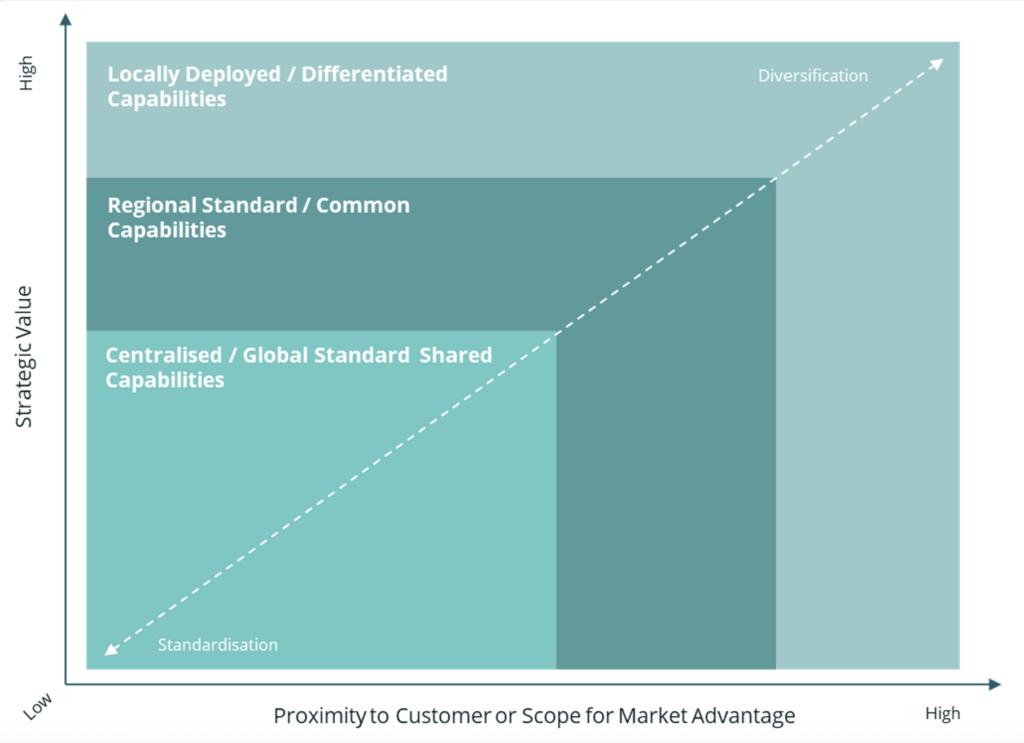
Times are tough, and funding is limited. So, money is crucial to invest in the areas that generate the most outstanding value, focusing on differentiation or operational efficiency.
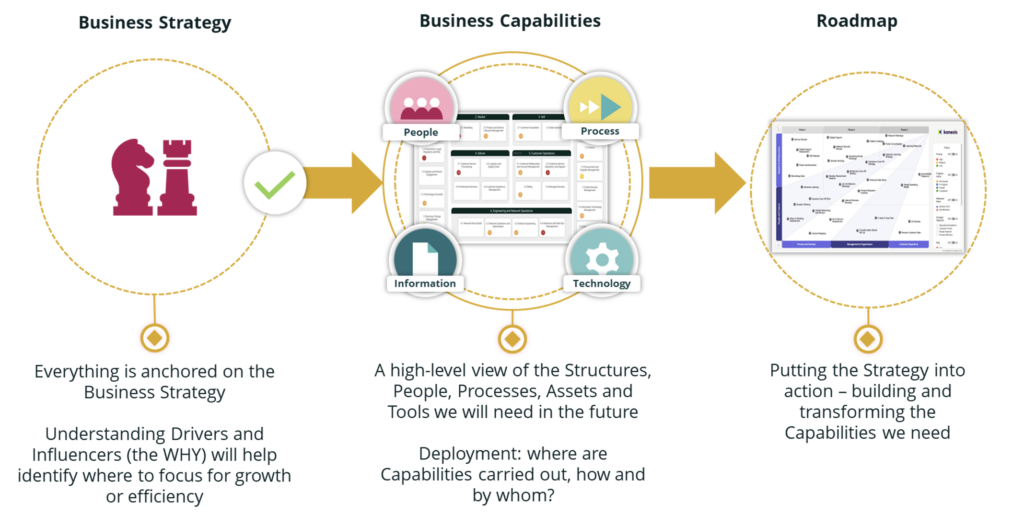
One of the techniques that we use to ensure spending is indeed focused on the right area is developing a capability model. The purpose is to describe your organisation on a page. Through stakeholder interviews and research, pain point assessment and maturity gaps (people, process, technology), you can immediately see the root causes and issues and misaligned objectives and spending. This will become a cornerstone asset, which can be used as a starting point to identify strategies (such as Build vs. Buy), understand strengths & weaknesses, identify investment priorities, and provide a basis for Operating Model design.
Capability models deliver tangible benefits. In 2017, MIT Centre for Information Systems Research (CISR) conducted research with 253 companies, which showed that organisations using capability modelling were better able to execute their operating model strategies. Deloitte’s Enterprise Business Architecture publications emphasise capability modelling as a foundation for operating model design and can link capabilities directly to value creation.
Fix:
Part of this work also involves separating inflight and planned projects, which, when overlayed on the capability model, can start to answer some of the most fundamental questions relating to current spend. What we often find is that:
- Significant sums were being spent in non-strategically agreed areas that bring only tactical benefits for a few stakeholders.
- On average, 63% of the in-flight-in-flight projects were tactical and not aligned with specific objectives, with 55% classified as misaligned spending.
- Any strategic roadmap that did exist was either hidden away, overloaded with information that made it difficult to understand, or not widely available. Ensure that you are aligning items on the strategic roadmap with what matters.

4. We need AI, now!
The launch of ChatGPT two years ago has changed the world more than any technology since the internet, but in a time frame far quicker than previous experiences. Using GenAI and for 2025 Agentic AI and being a data-driven company is at the forefront of boardrooms worldwide. However, it is not as simple as using AI to solve a business problem. AI is a tool like any other; unless you are feeding it the right information, you will get inconsistent results. Most CEOs do not want to train AI tools using sensitive data which makes the universally available LLM trickier to use.
Some recent research from IBM on data quality showed:
- Companies estimate that 32% of their data is inaccurate
- Poor data quality is the primary reason for 40% of failed AI/ML initiatives
- Finance teams spend 70-80% of their time on data gathering and verification rather than analysis
- Choosing the right path forward is Accenture. A recent Harvard Business School report showed a customer who has 1017 potential use cases for AI, so prioritisation is key.
This lack of clear, accessible data complicates forecasting demand, hindering compliance with SLAs, and enhancing resource allocation. It also poses challenges in maintaining an audit trail for financially significant processes and hampers the company’s ability to integrate modern technologies like Agentic AI. Research from KPMG states that only 35% of executives have a high level of trust in their organisation’s data.
The most common issue that we find is the lack of trust in financial reporting. It goes from one system to another, to another, and finally, three weeks after the month’s end, the reports are sent out -that no one trusts.
Fix:
Where we have seen AI working, we have seen organisations follow roughly the same pattern
- Start with a solid data foundation – no clean, connected data = no AI impact.
- Define AI’s role in decision-making – models should serve real business objectives.
- Invest in governance from day one – risk, bias & compliance can’t be afterthoughts.
- Upskill teams to work with AI – adoption fails when people don’t know how to use it

5. Your business is experiencing growing pains
This is clearly no applicable to all but one thing we notice is what got you to where you are is not going to take you to where you want to be. You be to begin to have that feeling of everything starting to creak, and you know you have to fix things, but you often do not know where to start.
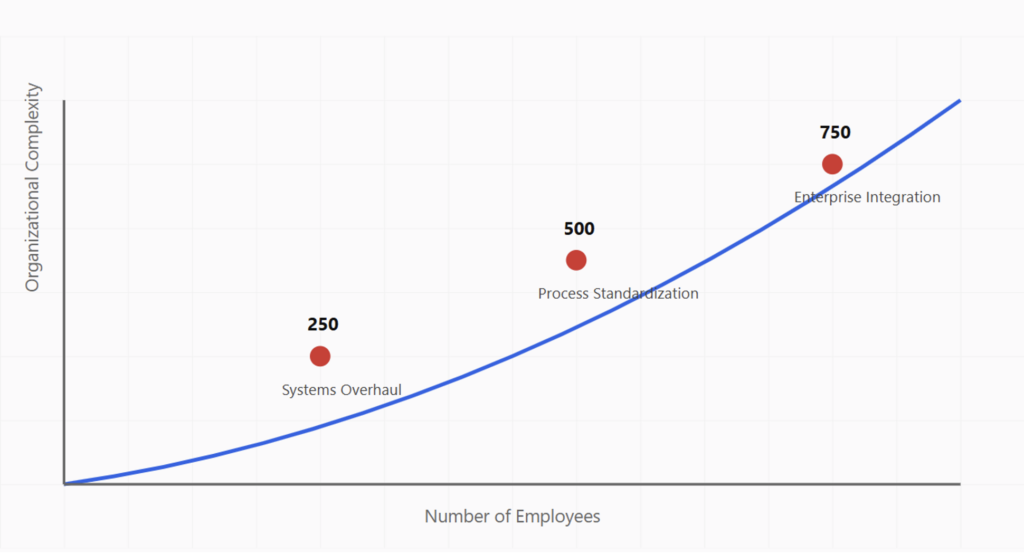
A study by McKinsey Growth Research found that critical breaking points typically occur at:
- 250 employees (first major systems overhaul needed)
- Manual processes start breaking down, particularly in finance and HR
- Spreadsheet-based reporting becomes unreliable and time-consuming
- Customer service quality becomes inconsistent
- 500 employees (process standardisation becomes critical)
- Departmental silos emerge, causing communication breakdowns
- Duplicate data entry and reconciliation become a significant overhead
- Multiple versions of truth emerge in reporting
- 750 employees (need for integrated enterprise systems)
- Disconnected systems create significant operational overhead
- Inability to get a single view of customer/operations/finance
Fix:
One of the biggest challenges we often see here relates to transformational fatigue. Either you do not have enough people to run the business day to day and implement a successful change programme, or the people are weary of another change programme hot on the heels of one that did not deliver. When this happens, your employees will just revert back to the old/current ways of working, and any promised change fails to materialise.

6. You need a strategic roadmap, that everyone can get behind.
Producing a good strategic roadmap is hard, getting one that is accessible to everyone in the company and personalised to their department or capability area is harder still, but it makes all of the difference.
Some of the key mistakes that we see with roadmaps are:
- Restricting roadmap access to a select group.
- Failing to show how day-to-day tasks relate to strategic goals and key outcomes.
- Relying on static formats and overwhelming stakeholders with static charts or slides
- Cramming too many items on one page and using inconsistent templates across units, making it hard to compare data.
- Relying on Gantt Charts for Strategic Visualisation. This often results in Compressing strategic initiatives into rigid timelines and locking in detailed dates too early, when high-level planning is still shifting.
- Many strategic roadmaps don’t draw attention to vital insights. When risks, funding gaps, and business objectives aren’t obvious, people lose interest
Fix
Design a good roadmap that encourages clear communication across teams. A design-driven approach helps you develop a roadmap whose visuals support your message.
These mistakes are very fixable, but a reliance on tools like PowerPoint and Excel or product-based roadmap tools will limit your ability to really show that vision and the dependency of interconnected projects and programmes to a wide range of stakeholders.
“Professor Robert Phaar at Cambridge University speaks about the need for a “strategic roadmap that is visually appealing to as many employees as possible.”

7. You have already done this, but it has not landed
It would be very rare for an organisation not to attempt any form of digital transformation, and you may have already done much of what has been described. However, the main issue is that it did not land with the business, and therefore, the change’s impact is much lower than hoped. The main reasons we have seen for this are:
- The transformation was hidden inside a 200-page static PowerPoint presentation.
- It was walked through at a Town Hall, sent out in advance, and is on your intranet, but the size and complexity of the document have made it inaccessible. The information is there, but no one is taking any notice of it.
- You did not change the compensation. As much as we hate to admit it, unless you have changed how your team is rewarded, you will not change their behaviours.
- The strategic roadmap is either overloaded with information, unavailable to a wide audience, or in a GANTT chart, making an effective on-a-page view impossible. Either way, very few people know how the planned initiatives are due to affect them or how the ones they are working on are dependent on others, and vice versa.
- There is no understanding lower down in the business what this means for them. If something is not understood, it is generally ignored.
This is a well-researched problem.
- McKinsey states that less than 30% of transformations succeed when employees don’t understand the change.
- In “Leading Change: Why Transformation Efforts Fail” by John P. Kotter the author emphasises the need for “clear, simple communication” over detailed documentation.
Fix
For any transformation communications to succeed, your key artefacts need to be understandable by the widest possible audience. Anyone who is disenfranchised from the transformation will be ambivalent at best and actively fight against it at worst.
Conclusion: Ensuring that any transformation starts correctly
These seven challenges – demand for operation efficiency, fragmented systems, misaligned vision, inefficient investments, poor data foundation, and failed transformation attempts – aren’t just inconveniences. They represent significant risks to your business:
- High operational costs that affect profit margins and ability to invest
- Not having a strategic roadmap that is widely understood
- Lost market opportunities while competitors move faster
- Increasing technical debt that becomes more expensive to address
- An employee base, disengaged from the transformation agenda
- Declining customer satisfaction due to poor experiences
- Reduced ability to leverage emerging technologies like AI
Why the Strategic Roadmap is Key
At Konexis, we truly believe, as we have seen it first hand the difference between a poor and high-quality strategic roadmap is critical for success. Our parent company, Konvergent, has helped dozens of blue chip organisations navigate digital transformation journey and we feel that Konexis is the only tool that:
- Has been designed purely for the strategic roadmap as it’s first thought
- Can give you a roadmap for the boardroom and a roadmap for the project team within a few minutes
- Only shows the data you want to show
- Clearly shows cross programme dependencies and costs
- Saves hundreds of hours of using manual tools
- High operational costs that affect profit margins and ability to invest
- Not having a strategic roadmap that is widely understood
- Lost market opportunities while competitors move faster
- Increasing technical debt that becomes more expensive to address
- An employee base, disengaged from the transformation agenda
- Declining customer satisfaction due to poor experiences
- Reduced ability to leverage emerging technologies like AI
When was the last time your CEO said “Its fantastic, I love it, I love it” when you present your strategic roadmap to them?
About Konvergent: We’ve helped leading organisations like Network Rail, DS Smith, BT, City and Guilds, Reed in Partnership, First Group, and WPP navigate complex business transformations. Our practical, results-focused approach has delivered measurable improvements in customer satisfaction, hy operational efficiency, and business agility.
Try it for free
Experience the difference Konexis can make to your strategic communication. Get started and try our strategic roadmap tool for free with a one month trial.
